
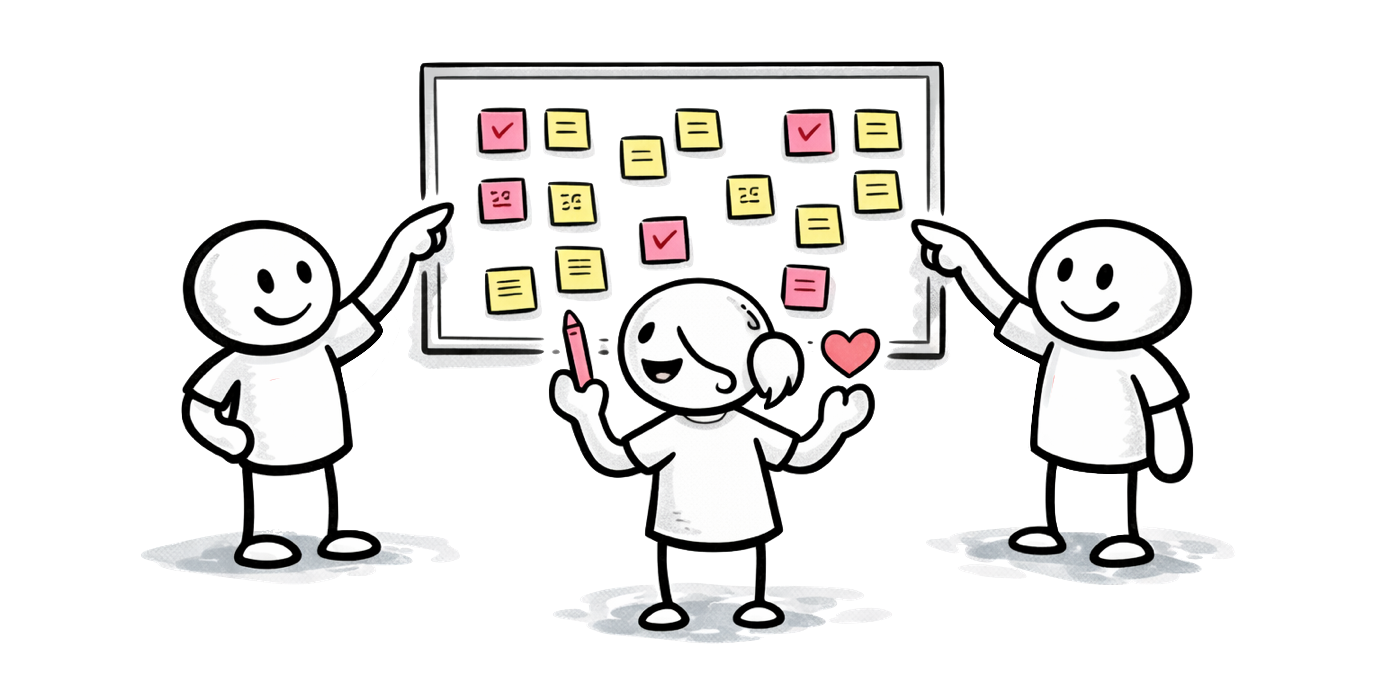
You have two hours. Fifteen people. And one objective: leave this workshop with a decision, a prioritized backlog, or a consensus on the roadmap.
The problem? Halfway through, three people are dominating the conversation, five others are looking at their phones, and you realize you have 20 minutes left to wrap up when you haven't even reached the main topic.
I know. I've been there. It took me about ten failed workshops — not catastrophic, just frustrating — to understand one thing: a good workshop is 70% structure and only 30% facilitation. Everything else (facilitator posture, creative activities, group energy) comes after. But without the framework, nothing holds.
This article is the framework I now use systematically. Five blocks. Precise timings. And three traps to absolutely avoid.
Your Workshop Starts 48 Hours Before
Most facilitators lose their workshop before it even begins. Why? Because they prepare their agenda the night before, and arrive in the room with 15 people who don't know exactly why they're there.
What changes everything:
48 hours before → Send participants the detailed agenda. Not a vague title. A document with the precise session objective in one sentence (if you can't write it in under 15 words, the objective isn't clear), the expected outcome at the end of the workshop ("We will have prioritized the 5 Q2 initiatives"), and any prerequisites ("Read the summary doc, 5 min").
24 hours before → Reminder with the link to the collaboration tool. Miro, FigJam, shared Google Doc — doesn't matter. What matters is that everyone arrives with the right access.
On the day → You gain 15 minutes of framing, because everyone knows why they're there. Those 15 minutes go into the quality of exchanges rather than logistics.
At Catena, with the "share" meeting function, we send participants a read-only link to the agenda before each session. They see the complete structure, the timings for each sequence, and arrive prepared. Engagement from the very first minute is radically different.
The 5-Block Structure (Non-Negotiable)
Here's the breakdown I use for all my 2-hour workshops, regardless of the method — retrospective, Design Sprint, OKR, backlog prioritization, Lean Canvas. The method changes. The structure doesn't.
1️⃣ Block 1: Framing (10 min)
The goal of this first block is to align everyone on the why and the what. Concretely: objective reminder in two minutes, agenda presentation with visible timings, then a quick weather check — "In one word, how are you arriving at this workshop?" — which takes five minutes and works wonders for loosening the atmosphere.
Why does it work? People need to know where they're going. Without this framing, you'll lose 30 minutes mid-session re-anchoring debates.
Classic mistake to avoid: Spending 20 minutes on "who did what since the last meeting". It kills your timing before you've even started. If it's critical, send a written recap beforehand.
2️⃣ Block 2: Divergence (40 min)
The goal here is to surface as many ideas, problems, and options as possible. But not just anyhow.
The sequence I use: individual work first (10 min, everyone notes their ideas on sticky notes or Miro), sharing in pairs or trios (15 min, group, exchange, refine), then collective share-out (15 min, display everything, clarify without judging).
The silence at the start — this solo phase that many novice facilitators find uncomfortable — is the cornerstone of the block. It forces everyone to contribute. Even the shyest participants have their voice. The people who usually dominate can't short-circuit this phase.
Classic mistake: Launching straight into a collective brainstorm. Result: 3 people talk, others weakly validate, and you leave with the same old ideas.
I use the Catena timer full-screen on a second display throughout this phase. Everyone sees the time ticking. It makes the group self-accountable and prevents overruns without me needing to play timekeeper.
3️⃣ Block 3: Convergence (35 min)
The goal: go from 50 ideas to 5 actionable decisions. This is often the hardest block to hold — not because it's complex, but because everyone wants to keep their ideas.
The sequence: dot voting (10 min, each participant has 3 votes, physical dot voting or Miro emoji), discussion on the top 5-7 voted items (15 min, dig, challenge, consolidate), then final prioritization with an Impact/Effort matrix (10 min).
Voting has an essential virtue: it prevents endless debates by giving an objective direction. The Impact/Effort matrix then forces honesty about real feasibility.
Classic mistake: Wanting to keep 15 ideas "just in case". No. You're there to decide, not to make a shopping list.
4️⃣ Block 4: Action Plan (25 min)
This is the block novice facilitators tend to rush — either from lack of time, or because they're relieved to have reached decisions. Yet it's the one that determines whether the workshop was worth anything.
For each retained initiative: Who does what? By when? (15 min). Then identification of potential risks and blockers (5 min), and definition of the next concrete step (5 min).
If you leave the workshop without an identified owner for each decision, nothing will happen. It's as simple as that. Collective good intention doesn't replace individual accountability.
Classic mistake: "We'll see later." No. We decide now, or the workshop was pointless.
5️⃣ Block 5: Closing (10 min)
Ten minutes that make all the difference in how participants perceive the session. Recap of decisions taken with owners (3 min), quick feedback round on a scale of 1 to 5 (5 min), thanks and announcement of the next session (2 min).
People leave with a feeling of clarity and progress. Even if everything wasn't perfect, they know what happens next. That's what transforms a one-off workshop into a team habit.
Classic mistake: Ending in a rush because you ran over. Result: feeling of being rushed, collective frustration, and a facilitator's credibility that takes a hit.
The 3 Deadly Traps
😵 Trap 1: Too Many Sequences
You planned eight different activities in 2 hours. That's too many. Each transition between two sequences costs between 3 and 5 unavoidable minutes: re-engaging attention, explaining the brief, distributing tools, answering questions. Over eight transitions, that's 30 minutes evaporated.
The rule: maximum 5 distinct sequences. Fewer is better. What you lose in variety, you gain in depth.
💬 Trap 2: Unstructured Debates
Someone raises a relevant tangential topic. Everyone piles in with good faith. Twenty minutes later, you're off-topic and no one knows how to get back on track.
The fix: The parking lot. A visible space — whiteboard, Miro section, Google Doc corner — where you note important but out-of-scope topics in real time. "That's a real question, I'm putting it in the parking lot, we'll come back to it if we have time." The person feels heard. The group stays on topic.
⌛️ Trap 3: Losing Grip on Timing
"Let's take five more minutes, it's important."
No. Those five minutes invariably become fifteen. And you finish thirty minutes late on a two-hour workshop.
The solution: Announce times out loud, regularly. "It's 10:32, we have until 10:42 for this phase." That makes everyone accountable — you included. And displaying a timer visible to all completely changes the dynamic: the group self-regulates, without you needing to intervene.
What It Looks Like in Practice
Here's a real example run recently: product backlog prioritization workshop / 2h / 12 people (PM, developers, designer).
| Time | Sequence | Duration |
|---|---|---|
| 2:00 - 2:10 PM | Framing: objective + quick weather check | 10 min |
| 2:10 - 2:50 PM | Divergence: feature listing (solo → pairs → collective) | 40 min |
| 2:50 - 3:25 PM | Convergence: vote + Impact/Effort matrix | 35 min |
| 3:25 - 3:50 PM | Action plan: who does what for the 5 priority features | 25 min |
| 3:50 - 4:00 PM | Closing: recap + feedback + next steps | 10 min |
Result: Finished at 3:58 PM. Everyone left with the prioritized backlog, identified owners, and clear deadlines. Was everything perfect? No. Did we move forward? Yes. That's what a good workshop looks like.
What I Wish I'd Known Earlier
A good workshop is not an accumulation of fun activities, a moment where everyone talks at once, or a meeting disguised with sticky notes.
A good workshop is a clear and respected framework, a precise objective with a tangible outcome, and moments of silence for thinking followed by moments of exchange for deciding.
The good news: it can be learned. And once you've internalized the 5 blocks, you can adapt them to any context: Scrum retrospective, OKR workshop, Design Sprint session, SAFe prioritization. The method changes, the structure stays.
Want to Try It on Your Next Workshop?
Catena lets you structure your agenda in minutes, share it with participants before the session, and run the workshop live with a timer synchronized across all screens.
👉 Try Catena for free • 100% free • No sign-up • No credit card
You'll find pre-built templates for sprint retrospectives, prioritization workshops, Design Sprints, OKRs, Lean Canvas — or create your own in ten minutes.
This article was written by Aymeric Proux, founder of Catena. To discuss facilitation or our tools, find me on LinkedIn.