
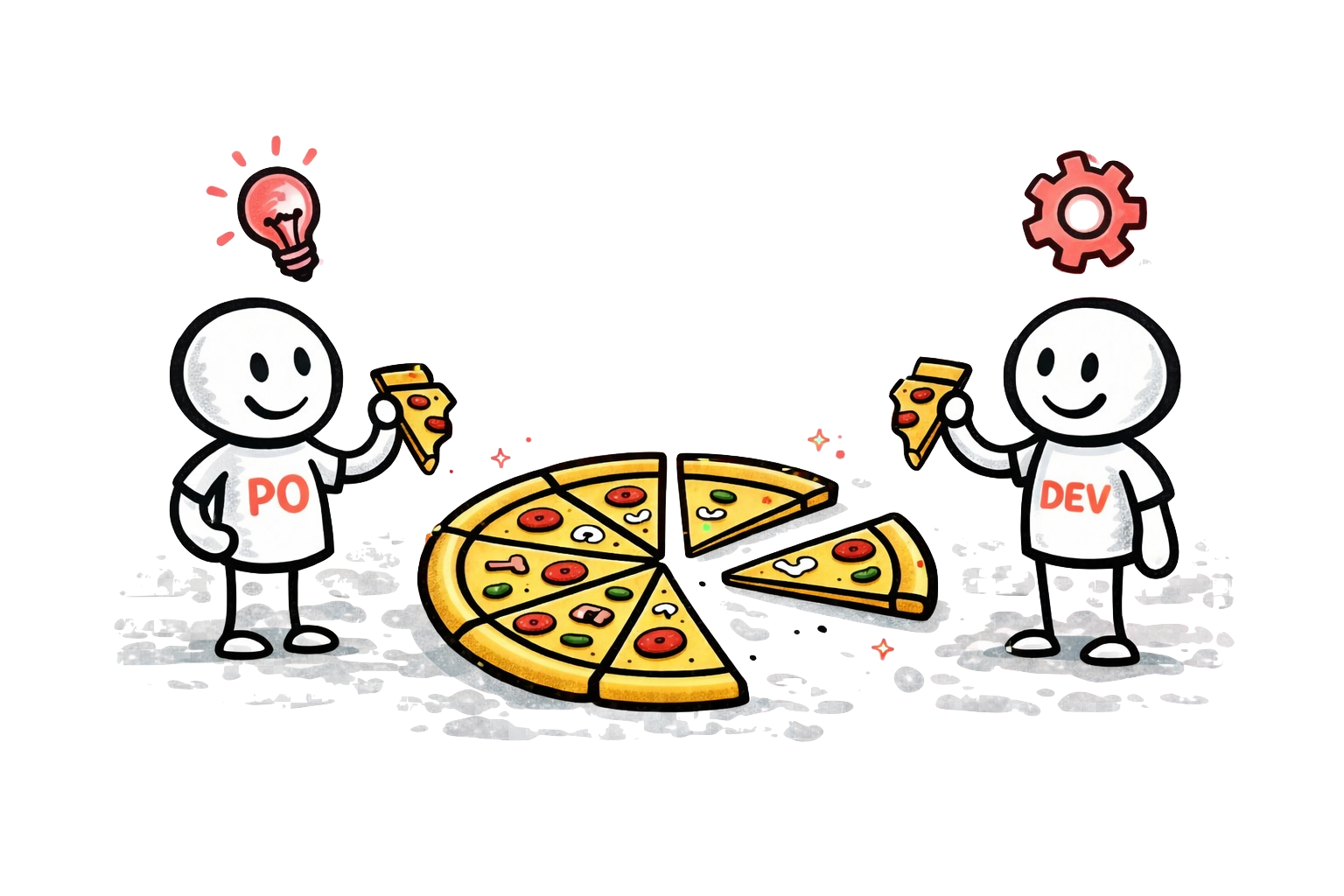
The Pizza Team, Revisited
Jeff Bezos's "Two-Pizza Team" is a sacred concept in the Agile world: a team should never be larger than what two pizzas can feed. That's 5 to 7 people maximum.
At Catena, we took this concept even further. Our team has exactly two people. And we ship features faster than a classic team of seven developers.
The secret? We work with four AI agents that have transformed how we design, develop, and deliver software. This isn't theory — it's our daily reality for several months now.
The results speak for themselves: cycle time divided by 5, costs reduced by 65%, and 3× more product hypotheses tested per month.
Here's how we build Catena, a SaaS tool for facilitating collaborative workshops, with our "Pizza Team 2.0".
Our Team Composition
The Humans: Two Complementary Roles
Our human team is deliberately stripped down to the essentials. On one side, me (Aymeric) as Product Owner and Founder. On the other, a senior developer (Tony) acting as technical architect.
My PO role has radically evolved. Today, I spend 70% of my time listening to users. Understanding their problems, identifying real needs, prioritizing features that deliver value. The rest is split between validating product decisions (20%) and orchestrating AI agents (10%).
This breakdown looks nothing like what I experienced before. In a classic setup, I'd have spent the majority of my time writing specs, structuring backlogs, and coordinating meetings. All those administrative tasks that pull a PO away from their real mission.
The senior developer, for his part, has freed himself from repetitive tasks to focus on critical architecture: security, performance, scalability. He no longer spends his days writing boilerplate code. He designs the technical foundations of the product.
The AI Agents: Four Virtual Specialists
Alongside the two of us, four AI agents make up the rest of the team:
- Specs Agent → Transforms my notes into structured technical specifications (User Stories, acceptance criteria, test scenarios)
- POC Agent → Generates functional prototypes in a few hours to quickly validate hypotheses
- Tests Agent → Handles complete test automation (unit, integration, end-to-end)
- Doc Agent → Takes care of all technical documentation (README, API guides, changelog)
This setup may sound artificial. In reality, it's extremely fluid. We call on agents when we need them, get a result in minutes or hours, and validate before moving to the next step.
The Gap vs. a Classic Team
Classic team (7 people)
💰 Cost: €50,000 - €70,000/month
⏱️ Cycle time: 2-3 weeks/feature
🧪 Hypotheses tested: 4/month
👥 Overhead: 20% of time in coordination
Our Pizza Team 2.0
💰 Cost: €12,000 - €15,000/month
⏱️ Cycle time: 3-5 days/feature
🧪 Hypotheses tested: 12/month (3× more)
👥 Overhead: ~0% (direct communication)
The gain: 5× faster, -65% cost, saving €420,000 to €660,000 per year.
But beyond the savings, it's the velocity gain that changes everything. Being able to test a product hypothesis in a few days instead of several weeks means learning 10× faster. It means building exactly what users need.
And "learning 10× faster" is also in our DNA. At Catena (Coverfield), we put continuous learning at the heart of our business (and personal) project. I'll come back to this in a future post on the Catena Blog.
A Feature from Start to Finish: The Synchronized Timer
Let's take a concrete example. A few weeks ago, we developed the "Synchronized Timer" — a timer visible on all screens simultaneously (facilitator's laptop, room display, participants' phones).
Day 1: From User Insight to Technical Spec
It all started with three user interviews. Three facilitators reported the same problem: "My participants can't see the timer on their phone."
I spent the afternoon transforming that feedback into specifications with Claude. My prompt: "I want to create a multi-screen synchronized timer for workshops. Context: Vue.js app, Node/Express backend. Need: sync < 1 second. Generate the technical specs."
After an hour and a few functional and technical exchanges with the agent, I had structured User Stories, a proposed WebSocket architecture, precise acceptance criteria, and test scenarios.
Time spent: 4 hours (vs. a full day before)
Day 2: From Concept to Working Prototype
The developer generated the base structure with Cursor. The AI produced the WebSocket server code, client code, and Vue.js components.
In 3 hours: working prototype. Latency < 500ms. We brought in two users that afternoon to test. Immediate validation: "That's exactly what we need."
In a classic team: 3 days minimum for a POC
Day 3: Production
The developer focused on the critical parts (robust connection handling, failover, optimizations). The AI generated all the standard code: UI components, integrations, tests.
End of day: feature coded and tested.
Day 4: Review and Production Deployment
In-depth code review, load tests (500 simultaneous users), documentation generated by the Doc Agent, deployment to production.
Bottom line: 4 days, 2 people, feature in production
In a team of 7, this same feature would have taken 15 working days.
What AI Does (and Will Never Do)
✅ What AI Does for Us
AI excels at structuring and generating. It transforms raw information into something usable and structured.
- Writing formatted specs
- Boilerplate code and standard integrations
- Automated tests
- Technical documentation
- Rapid prototypes to test hypotheses
❌ What AI Does NOT Do
But there are things AI absolutely does not do:
It doesn't understand the WHY → When a user requests a feature, AI can't guess the underlying problem. That's my job to dig into.
It doesn't PRIORITIZE → When we have 10 feature ideas, AI can't decide which to build first. It doesn't understand product strategy.
It doesn't DESIGN critical architecture → For security, performance under heavy load, scalability, you need an experienced human brain.
It doesn't VALIDATE quality → It can generate tests, but not judge whether coverage is sufficient. It can produce code, but not identify forgotten edge cases.
The real change
What AI fundamentally changes is the split between execution time and thinking time.
Before: 60% execution, 40% thinking
Now: 30% execution, 70% thinking
The Learnings
What We've Learned
Prompt quality makes all the difference. Early on, we gave vague instructions and got mediocre results. Today, we have a library of tested and refined prompts.
AI never replaces code review. A human must always review generated code. AI can produce code that works but has security, performance, or maintainability issues.
Go/no-go decisions have become easy. Before, we'd hesitate between investing 2 weeks to test a hypothesis or deciding without testing. Today, we generate a POC in 1 day and decide on concrete data.
Pitfalls to Avoid
⚠️ The temptation to delegate everything → AI can optimize, but it doesn't define vision. We keep the reins on strategy.
⚠️ Tool dependency → If Claude or ChatGPT go down, our productivity drops. We have multiple tools running in parallel.
⚠️ Variable quality → Sometimes AI produces excellent code, sometimes shaky. Every output goes through human validation. Always.
Who It Works For (and Who It Doesn't)
✅ It works if:
- You're bootstrapping with a limited budget
- You need to test lots of hypotheses quickly
- You have at least one highly skilled senior developer
- You accept learning (prompts, workflows, validation)
❌ It's NOT right if:
- Your product is ultra-complex (banking, healthcare, aerospace)
- You need specialized teams (design, QA, DevOps)
- You don't have a senior developer (technical debt risk)
- You prefer a traditional approach with established processes
Our Bet on the Future
By reducing our team to two people and four AI agents, we made a bet. The bet that velocity matters more than headcount. That decision quality matters more than code volume. That understanding users matters more than multiplying features.
The numbers prove us right:
✅ We ship 5× faster
✅ We test 3× more hypotheses
✅ We make decisions based on concrete data
✅ We've saved hundreds of thousands of euros per year
But above all, it's a matter of focus. Today, I spend the majority of my time doing my real job as Product Owner: understanding users, identifying their problems, building the right solutions.
We don't claim to have found the magic formula. This approach constantly evolves. We learn every day. But one thing is certain: the Pizza Team 2.0 is our way of working. It's our competitive advantage. It's how we build Catena.
Want to Discover Catena?
If you run collaborative workshops, Agile rituals, or team working sessions, Catena can help you better structure them, pilot them in real time, and analyze them.
👉 Try Catena for free 100% free • No sign-up • No credit card
Built with passion by a Pizza Team 2.0 🍕🤖
This article was written by Aymeric Proux, founder of Catena. To discuss our way of working, find me on LinkedIn.