
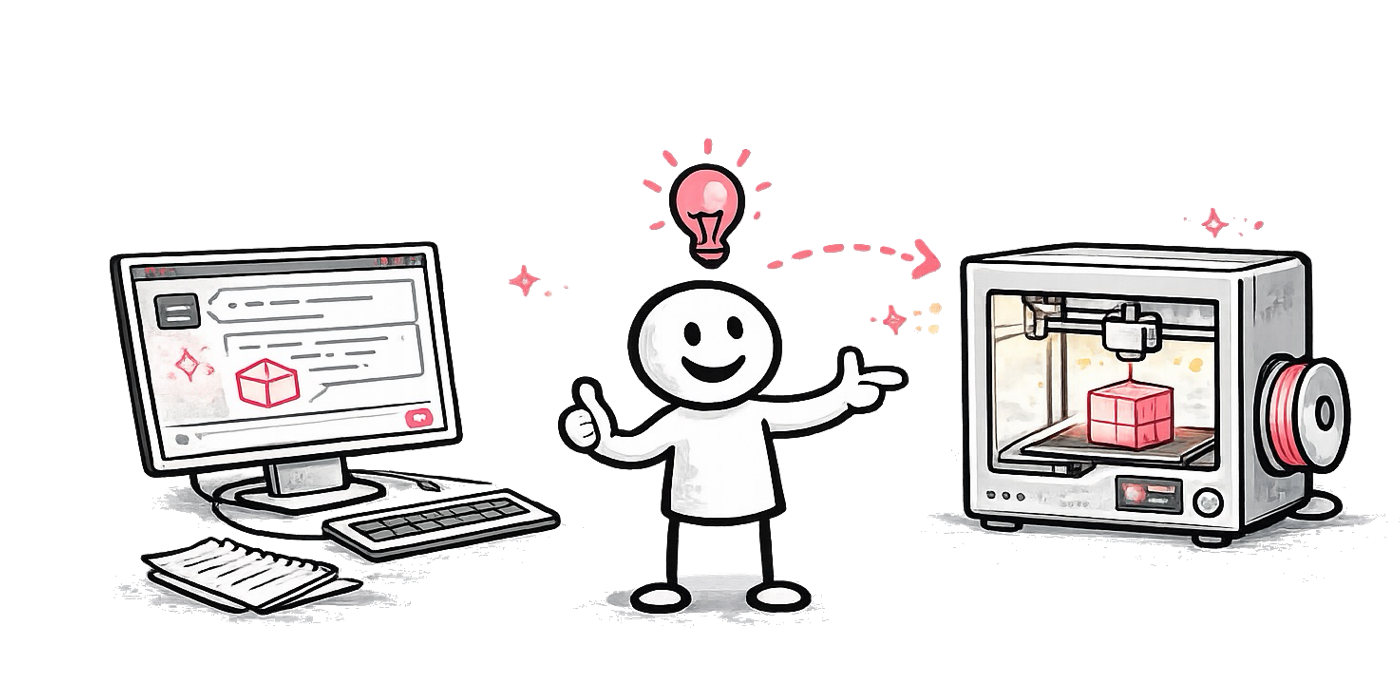
The Forgotten Promise
You remember those articles? "Imagine a world where everyone could repair their devices at home. Where planned obsolescence no longer existed. Where instead of throwing something away because a plastic clip broke, you'd print a replacement part in your living room. 3D printing is going to change everything."
We read that almost 10 years ago. In every tech magazine, on every blog, at every conference.
And yet. In 2026, home 3D printing is still a niche. A hobby for enthusiasts, makers, and weekend engineers. We're nowhere near the "everyone has a 3D printer at home" we were promised. The general public didn't follow.
The question is: why? Printers have become reliable and affordable, you can find excellent machines for under €200. Materials have diversified. Maker communities share thousands of free models. Everything was in place. Except one thing.
The Real Barrier Was Never the Machine
The problem isn't the printer. The problem is what happens before hitting "print".
To print a part, you first need to model it in 3D. And modeling in 3D means learning how to use CAD software. Fusion 360, Blender, SketchUp, FreeCAD... These tools are powerful, but their learning curve is brutal. We're talking dozens, sometimes hundreds, of hours before you can design anything even moderately complex.
It's a time investment most people simply can't afford. Not for lack of desire or intelligence, but for lack of time and patience facing interfaces built for professionals.
The result: the majority of 3D printer owners spend their time downloading existing models from Thingiverse or Printables. They print what others have designed. The day they need a custom part, a specific fridge clip, a support tailored to their setup, an unobtainable spare part, they hit a wall.
This "last mile" between the need and the 3D file is what killed the promise.
A Maker Facing the Same Wall
I speak from experience. Creating physical objects has been part of my DNA for a long time.
With Coverfield, I designed, manufactured, and sold iPad accessories, book-shaped covers, mastering the entire chain, from idea to shipped package. Design, material sourcing, production, logistics, sales. Everything.
A few years later, with Totm+Travl at Padawanlab, we launched a Kickstarter for a smart dock for Apple Watch. An oak wood object from the Jura region that combined a charging dock, external battery, and HomeKit trigger.
Kickstarter Totm+Travl
Funded at 240% (€36,000 / €15,000 goal)
Covered by 9to5Mac, Mac4Ever, Geeky Gadgets
Designed and manufactured in France (Jura oak wood)
In both cases, 3D prototyping was a central step. And in both cases, I had to invest considerable time learning CAD software. Hours spent on Fusion 360 tutorials, mastering constraints, sketches, boolean operations. Hours that had nothing to do with the creation itself, but with learning the tool.
The creator's paradox
You know exactly what you want to make, you can sketch it on a napkin, but between that sketch and a printable .STL file, there's a chasm. A chasm called "CAD skills".
What Just Changed
On April 28, 2026 (on my birthday 😅), Anthropic announced "Claude for Creative Work". Among the announcements, one caught my attention more than the others: MCP (Model Context Protocol) connectors for Autodesk Fusion, Blender, and SketchUp.
Concretely, this means you can now talk to Claude to create and modify 3D models directly in these professional tools. In plain language. "Create a rectangular enclosure 80x50x30mm with 2mm fillets and a 5mm hole centered on the top face." And Claude executes in Fusion. Not an approximate mesh, a parametric model, with construction history, editable.
What the Autodesk Fusion connector enables
Create sketches and apply constraints
Extrusions, revolutions, boolean operations, fillets
Assembly and component management
All through natural language conversation
SketchUp goes even further for simple cases: you can describe an object, add reference images (a sketch, a photo), and get a downloadable .skp file. Without even having the software installed.
"Prompt-to-print" is no longer a futuristic concept. It's a workflow that works today.
What This Actually Changes
Think about it for a second. The clip on your dishwasher that broke? You take a photo, describe the part, Claude generates the model, you print it. Total time: 30 minutes instead of throwing the appliance away or waiting 3 weeks for an overpriced spare part.
The custom support for your desk setup? One prompt, a few adjustments, print. No need to spend hours hunting for an "almost right" model on Thingiverse.
But beyond the weekend tinkerer, it's for entrepreneurs and creators that the change is most radical.
The dream world of "idea to prototype overnight" is arriving.
A maker with a good physical product idea will be able to design, iterate, and produce a first prototype without going through the "I'll spend 6 months learning CAD" phase.
For the environment, the implications are real too. Fewer products thrown away because a €0.50 plastic part gave out. Less overconsumption. More repair. Exactly what those articles promised 10 years ago.
From Physical to Digital, the Same Drive
Today, I no longer make physical objects. I build Catena.
But the drive is exactly the same as with Coverfield or Totm+Travl. Identify a problem, imagine a solution, prototype it, put it in users' hands. Iterate. Improve. Repeat.
And AI has transformed this process in the same way it's transforming 3D printing. I wrote about it in detail in a previous article, How We Build Catena with a Team of 2 (+ AI Agents): we develop Catena with two people and four AI agents, we ship 5x faster than a classic team of seven, and we test 3x more product hypotheses each month.
The parallel
What AI agents do for our code (removing the friction between intention and execution) Fusion and Blender connectors are going to do for physical objects.
Software: prompt → code → deploy ("prompt-to-ship")
Physical: prompt → 3D model → print ("prompt-to-print")
🔁 The loop is closed.
AI Doesn't Replace the Creator
Let's be clear: AI isn't going to turn everyone into a product designer, any more than it turns everyone into a developer. Vision, taste, understanding of user needs, the ability to iterate in the right direction — all of that remains deeply human.
But it removes the technical barrier between "I have the idea" and "I have the prototype". It separates creative know-how from software know-how. You know what you want to make? AI knows how to model it.
And that is a real revolution. Not the same one we were sold 10 years ago. Not as spectacular, not as utopian. But more realistic. More concrete.
The world where everyone has a 3D printer at home to repair their appliances? It's coming. Maybe. Not because printers have changed. But because the last mile (modeling) is starting to disappear.
And for the creators, makers, and entrepreneurs who have always had their heads full of ideas but never had time to learn Fusion 360? Their moment is arriving.
Mine never stopped.
Want to Discover Catena?
If you run collaborative workshops, Agile rituals, or team working sessions, Catena can help you better structure them, pilot them in real time, and analyze them.
👉 Try Catena for free 100% free • No sign-up • No credit card
Built with passion by a creator who never stops 🚀
This article was written by Aymeric Proux, founder of Catena. To discuss creation, making, and AI, find me on LinkedIn.