
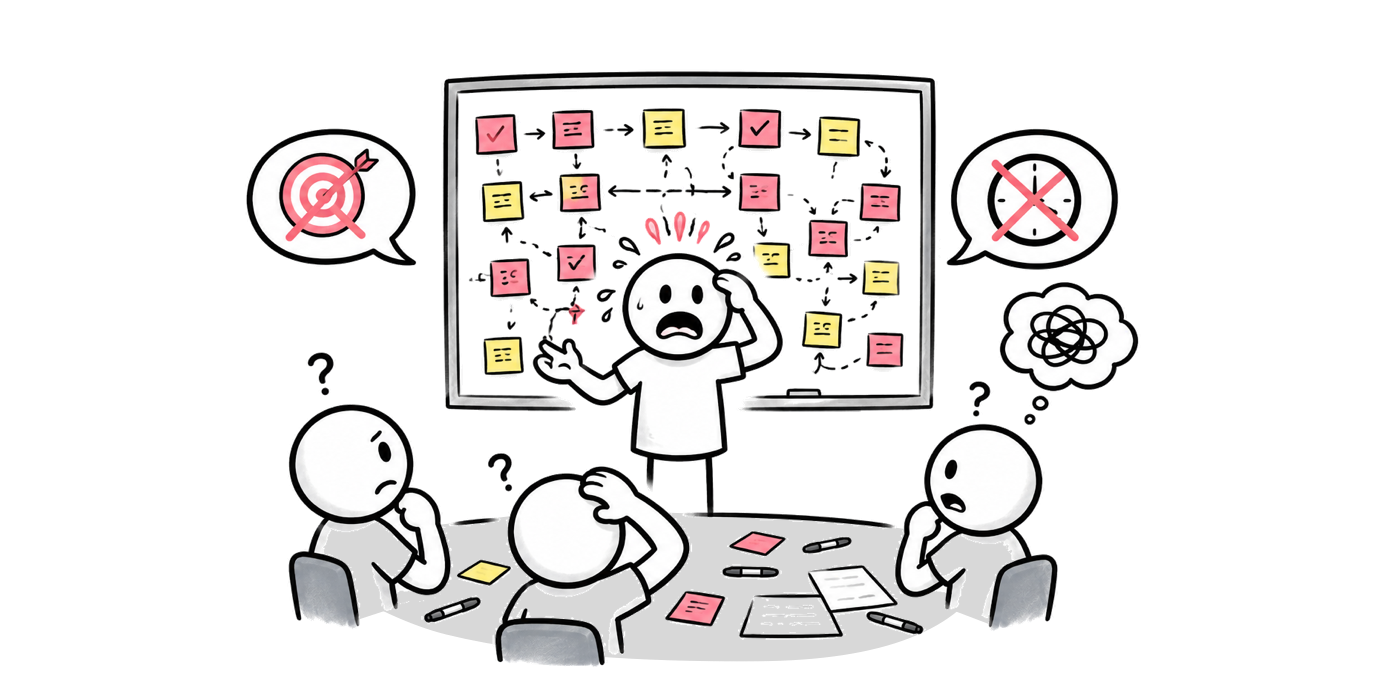
I've facilitated a lot of workshops before understanding what wasn't working in most of them. Not the bad ones, the almost good ones. The ones that ended with a diffuse feeling of frustration. We'd worked hard, it was lively, people had participated. And yet, walking out of the room, something felt off.
It took a while to put my finger on it. Not because the mistakes were subtle, but because they were hiding behind an appearance of seriousness: a detailed agenda, well-thought-out activities, timing announced at the start of the session. On paper, everything was there.
Except the problem didn't come from what was missing. It came from the combination of two things that weren't working together, and the effect that produced when both were present at the same time.
Here's what I wish someone had explained to me from the beginning.
Mistake #1: Too Many Sequences
You're preparing a 2-hour workshop. You have ideas, you have methods, you want to be thorough. So you break it down. An icebreaker to start, a group divergence phase, a dot vote, a collective discussion, a prioritization matrix, an action plan, a quick retrospective, an express feedback round. Plus a few transitions, a framing moment, and a break. That's 12 sequences. You time each one: 5 min here, 8 min there, 12 min for that one. You add it up. It fits in the 2 hours, exactly.
The problem is that you've treated the workshop like a project plan. You've filled in the boxes.
But a workshop isn't a plan. It's a space for collective thinking. And collective thinking needs room to breathe, what we call drift. Those moments when a discussion heads in an unexpected but productive direction. When a question triggers an important realization. When you need 3 more minutes for an idea to fully mature.
Drift isn't a bug. It's a feature. It's part of the process. The problem is when you haven't left any room for it, because it shows up anyway, but in an uncontrolled way. It smashes the tight schedule you'd planned, and everything chains together poorly until the end.
The 5-Block Rule
A 2-hour workshop doesn't need more than 5 distinct sequences. 5 blocks of 20 to 40 minutes, each with a clear objective and room to breathe. What you lose in variety, you gain in depth, and in control of time.
I described my "standard" (adaptable) structure in a previous post: How to Structure a 2-Hour Workshop for 15 People
The real work of workshop design is choosing the right sequences, those with real value, those that carry the key message of the session, and having the courage to cut the others. Not because they're bad. Because they're taking space from moments that need to breathe.
Mistake #2: No Visible Timer
You announce "30 minutes for this phase". The group gets to work. You facilitate, you circulate, you regulate the exchanges. And then, imperceptibly, you lose track of time. Someone asks an interesting question. A discussion takes off. You hesitate to cut it, it's productive, after all. You glance at your watch 25 minutes later. Someone asks "how much time is left?". You're already at the limit.
The absence of a visible timer is a problem in itself. But it's an aggravating problem, and that's where it becomes important to understand.
If the workshop is well calibrated (few sequences, planned space), the absence of a visible timer remains manageable. You can get through it on instinct, because the blocks are wide and the margin exists. It's not ideal, but it holds.
If, on the other hand, the workshop is overloaded with sequences, and each one is timed as tightly as possible, the absence of a visible timer turns the improbable into the inevitable. Holding a tight schedule to the minute across 12 mini-activities with a timer is already very hard. Without a timer visible to the group, it's humanly impossible.
The session runs off the rails. Not because the facilitator is bad. Because the conditions didn't allow it to hold.
A visible timer, displayed full-screen, readable from every corner of the room, radically changes the dynamic. The group self-regulates. Participants see the time passing. Debates naturally concentrate. And above all: the facilitator no longer needs to play the timekeeper announcing that the phase is over. The timer does it for them.
Mistake #3: The Sum of Mistakes #1 and #2
The third classic mistake, "no deliverable at the end of the workshop", is presented separately in most guides. And it's true that it exists: workshops that end in good spirits, with lots of ideas floating around and zero decisions made.
But if you trace it back to the cause, you always arrive at the same place. A workshop without a deliverable is almost always one where time ran out at the end of the session. The last block, the action plan, the owners, the deadlines, was sacrificed because the previous phases had overrun.
And the previous phases had overrun because the workshop was overloaded, and the timing wasn't held.
The truth about these "3 mistakes"
They are in reality 2 fundamental mistakes, and their combined effect. A poorly calibrated workshop (too many sequences) + poorly held timing (no visible timer) = systematic overrun, sacrificed deliverable, collective frustration. The 3 problems don't add up. They multiply.
That's why fixing only one of the two isn't enough. A well-calibrated workshop but without a timer often finishes on time, but with uneven exchange quality and a feeling of rushing. A workshop with a perfect timer but too many sequences always runs late, no matter what, because the system is structurally impossible to hold.
Both conditions are non-negotiable. And their combination is the only real solution.
What This Looks Like in Practice
A good workshop rests on two pillars. First, calibrate well: choose the sequences that genuinely have value for reaching the session's central objective, limit to 5 blocks maximum, and explicitly plan margin into each block, not as wasted time, but as space for controlled drift. Drift is part of the process. It must be planned, not endured.
Then, hold the timing well: display a timer visible to everyone from the start of each sequence, announce transitions out loud ("we have 5 minutes left"), and have the discipline to respect the blocks even when the discussion is good. It's not cutting creativity, it's protecting the rest of the session.
In our experience at Catena, these two elements change everything. Not because they make the workshop more rigid. Because they create the conditions for the group to fully invest in it, knowing the framework holds.
And the Deliverable?
When both conditions are met, well-calibrated workshop, timing held, the final block truly exists. It isn't sacrificed. The last 20% of the session is dedicated to what gives value to everything else: who does what, by when, with which resources.
The deliverable isn't a section added at the end as a formality. It's the natural result of a workshop that worked well. And its absence is almost always the symptom of something that went off track earlier, not a mistake to fix at the end.
Save Your Next Workshop From These 3 Mistakes!
Catena lets you structure your agenda in minutes, share it with participants before the session, and run the workshop live with a timer synchronized across all screens, facilitator laptop, room display, participant phones.
👉 Try Catena for free 100% free • No sign-up • No credit card
100+ ready-to-use workshop frameworks, or create your own in 10 minutes.
This article was written by Aymeric Proux, founder of Catena. To discuss facilitation or our tools, find me on LinkedIn.